|
Switching Targets: What It Takes to Move Beyond HRP2-Based Rapid Tests
When a parasite has lost pfhrp2 and pfhrp3, no amount of improving an HRP2-based test will find it. The alternative is to target a different protein: Plasmodium lactate dehydrogenase (LDH), a metabolic enzyme that every parasite expresses regardless of its hrp2/3 status. Available products differ in configuration — LDH alone, or HRP2 and LDH on separate lines — and that choice affects more than sensitivity.
When a parasite has lost pfhrp2 and pfhrp3, no amount of improving an HRP2-based test will find it. The alternative is to target a different protein: Plasmodium lactate dehydrogenase (LDH), a metabolic enzyme that every parasite expresses regardless of its hrp2/3 status. Available products differ in configuration — LDH alone, or HRP2 and LDH on separate lines — and that choice affects more than sensitivity.
Where deletions are common, the gain is substantial. A multisite study published this year in The Lancet Microbe enrolled 1,800 febrile patients across six districts of Ethiopia with contrasting transmission intensities and deletion frequencies. Of 657 microscopy-confirmed P. falciparum infections, the HRP2-only test missed 160 (24%), while a test carrying separate HRP2 and PfLDH lines missed 20 (3%). Against microscopy, sensitivity was 75.7% for the HRP2-only test and 97.1% for the dual test — and the first figure conceals the mechanism: 96.7% against wild-type parasites versus 7.8% against those carrying double deletions. The dual test reached a 90% probability of detection at 97 parasites per microliter, against 2,218 for the HRP2-only comparator. These data informed Ethiopia’s national policy shift away from HRP2-based tests.
Switching is not universally advantageous, however. In a febrile population in Kédougou, Senegal, which the authors describe as having low rates of deletions, the PfLDH lines alone on three tests reached 61–64% sensitivity, below the 71% of an established, WHO-prequalified HRP2-based comparator; the best-performing product, at 78%, owed that advantage to its HRP2 line rather than its LDH line. This is the documented lower sensitivity of LDH-based tests for P. falciparum, and it is the reason the decision cannot be made on principle alone. Configuration carries a surveillance consequence too: separate HRP2 and LDH lines flag a possible deletion when one is positive and the other is not, while a single combined line is simpler to read but silent on that question.
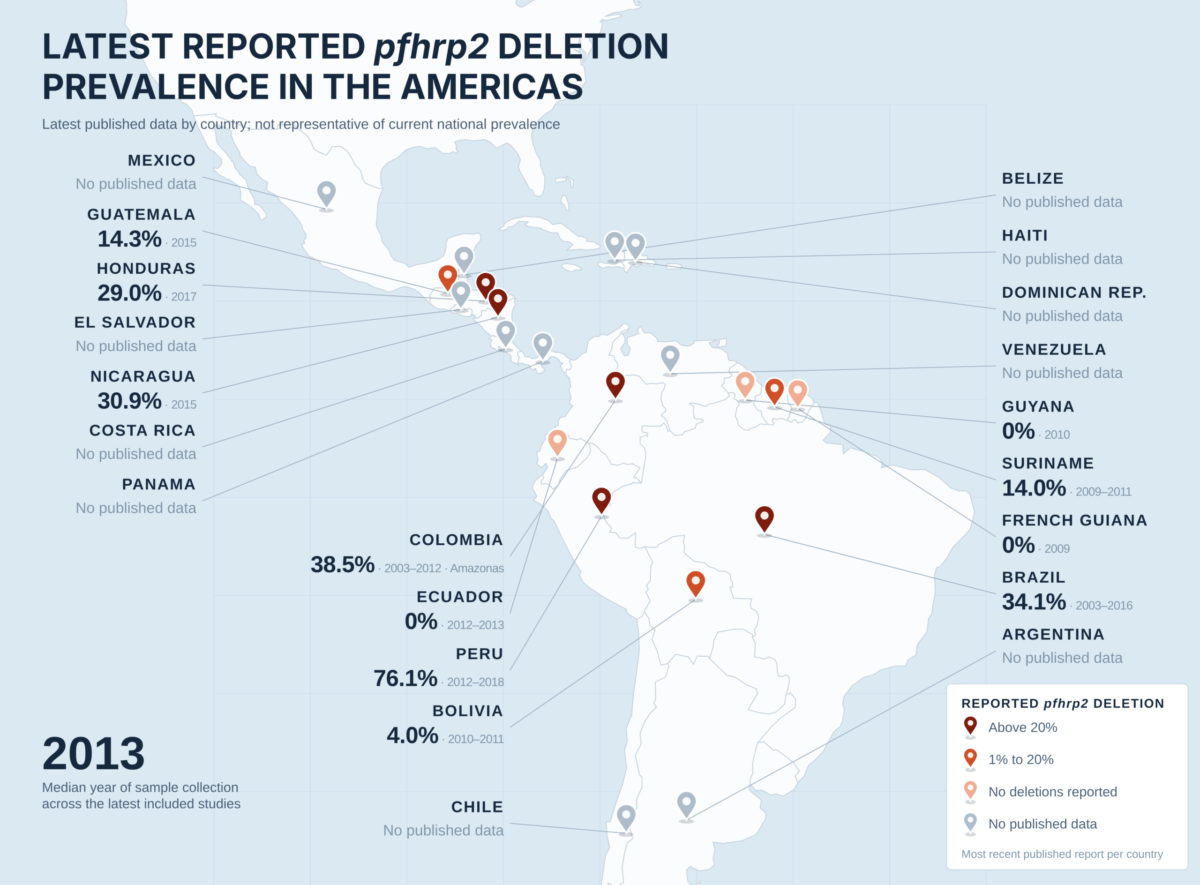
This is why WHO advises moving away from exclusive HRP2-based RDTs only where at least 5% of P. falciparum cases are missed because of deletion-related false negatives — a threshold defined by cases missed, not by the share of circulating parasites carrying deletions, a distinction easily lost. The operational constraint is equally real: no non-HRP2 product currently meets WHO prequalification requirements, specific non-prequalified products are accepted under defined conditions, and WHO is explicit that procurement decisions should rest on local epidemiology and expert consultation. For the Americas, where deletion prevalence can differ sharply between neighboring districts, that local evidence is exactly what molecular surveillance is positioned to produce.
Reference
Zeleke AJ, Bezabih MK, Ejigu LA, et al. Data-driven diagnostic reform in Ethiopia’s transition to pLDH-based malaria rapid diagnostic tests amid rising pfhrp2/3 deletions: a multisite, facility-based, cross-sectional study. Lancet Microbe. 2026. https://doi.org/10.1016/j.lanmic.2026.101515
Sambe BS, Zobrist S, Sheahan W, et al. Performance and usability evaluation of three LDH-based malaria rapid diagnostic tests in Kédougou, Senegal. Parasit Vectors. 2025;18:280. https://doi.org/10.1186/s13071-025-06914-9
World Health Organization. Selecting and procuring malaria RDTs. Geneva: WHO Global Malaria Programme.https://www.who.int/teams/global-malaria-programme/case-management/diagnosis/rapid-diagnostic-tests/selection-and-procurement |