|
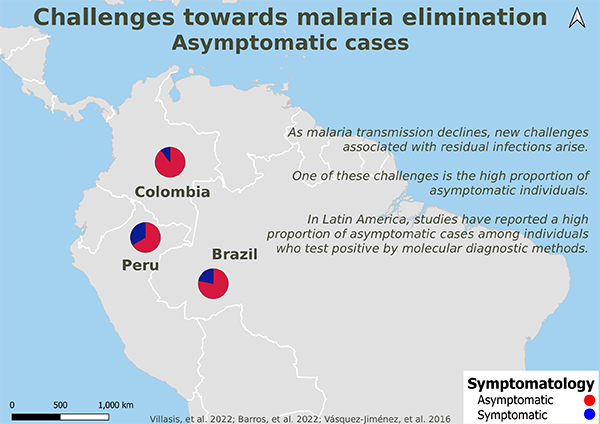
Malaria elimination in the Americas depends not only on reducing reported cases, but also on understanding what remains hidden. Across the region, growing evidence shows that asymptomatic infections, human mobility, and local ecological conditions continue to shape transmission in ways that routine surveillance alone cannot fully capture.
At the same time, advances in molecular surveillance are transforming how researchers and public health programs understand malaria dynamics. From parasite genomics to vector population studies, these approaches are helping reveal patterns of transmission, insecticide resistance, and parasite diversity that were previously difficult to detect. |
| |
|
Daniel E. Neafsey |
|
Genomic data can play an important role in understanding and controlling the Anopheles mosquito vectors of malaria. This analysis of over 1000 genome sequences of Anopheles darlingi, the most important malaria vector in South America, shows that the species has very high genetic diversity across its geographic range, and that insecticide resistance occurs without the target site mutations in the vgsc and ace-1 genes that are common in African and Asian vectors. An. darlingi instead responds to insecticides primarily through metabolic resistance, with evidence of parallel natural selection on the same cytochrome p450 genes in many populations. |
|
|
| |
|
This genomic dataset gives a portrait of insecticide pressures across different landscapes in South America, suggesting exposure in both agricultural and public health contexts, and yields candidate markers that can support future genetic surveillance for resistance. |
| |
|
Tracking the Evolution of South America’s Main Malaria Vector |
A new study published in Science analyzed more than 1,000 genomes of Anopheles darlingi, the principal malaria mosquito vector in South America. The research included mosquito samples collected across six countries, including Peru, Brazil, Colombia, Venezuela, Guyana, and French Guiana.
The results suggest that Anopheles darlingi populations are evolving in response to insecticide exposure, potentially making some mosquito populations harder to control over time. Researchers identified genetic signals associated with adaptation and population differentiation across environmental and geographic contexts.
|
|
|
| |
|
LAMP: Expanding Access to Molecular Detection |
Loop-mediated isothermal amplification (LAMP) is an increasingly used molecular tool for malaria diagnosis, particularly in field and low-resource settings where access to conventional molecular methods remains limited.
Unlike PCR, LAMP does not require complex thermocycling equipment and can generate results more rapidly, making it more feasible for surveillance activities outside centralized laboratories. This has positioned LAMP as a promising approach for strengthening malaria detection in remote and endemic regions.
Studies conducted in the Peruvian Amazon have highlighted the value of LAMP for detecting low-density and asymptomatic infections that may remain undiagnosed through routine microscopy or rapid diagnostic tests. Pilot implementation studies showed that LAMP can be successfully applied under challenging field conditions, supporting malaria surveillance in communities where transmission is often difficult to detect.
More recent work has also explored the development of colorimetric LAMP assays targeting multicopy genes of Plasmodium vivax and Plasmodium falciparum, improving the sensitivity of parasite detection while simplifying result interpretation in field settings.
This is particularly important because asymptomatic and low-parasitemia infections can continue sustaining malaria transmission while remaining largely invisible to routine surveillance systems.
However, challenges remain. The performance of LAMP may vary depending on parasite density, sample preparation, and implementation conditions. Expanding access to molecular tools also requires laboratory training, quality assurance systems, sustainable supply chains, and integration into existing surveillance strategies.
As malaria elimination efforts advance across the Americas, tools such as LAMP may play an increasingly important role in improving early detection and strengthening molecular surveillance capacity throughout the region.
|
|
|
| |
|
Serra-Casas, E., Manrique, P., Ding, X. C., Carrasco-Escobar, G., Alava, F., Gave, A., ... & Gamboa, D. (2017). Loop-mediated isothermal DNA amplification for asymptomatic malaria detection in challenging field settings: technical performance and pilot implementation in the Peruvian Amazon. PloS one, 12(10), e0185742.https://journals.plos.org/plosone/article?id=10.1371/journal.pone.0185742
Nolasco, O., Infante, B., Contreras-Mancilla, J., Incardona, S., Ding, X. C., Gamboa, D., & Torres, K. (2020). Diagnosis of Plasmodium vivax by loop-mediated isothermal amplification in febrile patient samples from Loreto, Perú. The American Journal of Tropical Medicine and Hygiene, 103(4), 1549. https://pmc.ncbi.nlm.nih.gov/articles/PMC7543827/
Nolasco, O., Montoya, J., Rosales Rosas, A. L., Barrientos, S., Rosanas-Urgell, A., & Gamboa, D. (2021). Multicopy targets for Plasmodium vivax and Plasmodium falciparum detection by colorimetric LAMP. Malaria journal, 20(1), 225. https://pmc.ncbi.nlm.nih.gov/articles/PMC8135177/ |
| |
|
Expanding Collaboration Across the Americas |
MMS Americas continues strengthening regional collaboration by engaging institutions and research groups interested in malaria molecular surveillance across Latin America.
Current efforts include outreach to laboratories and institutions that are not yet formally part of the network, with the goal of expanding collaboration, promoting knowledge exchange, and strengthening regional capacity in molecular surveillance and bioinformatics.
The network also seeks to support harmonization of protocols and data analysis approaches to facilitate comparison of information generated across countries.
Institutions interested in learning more about the network or future collaborations are invited to contact:
mmsamericas.network@gmail.com
|
|
|
| |
|
APMEN Joint Working Groups Meeting 2026
|
| |
|
Bangkok, Thailand 27–30 April 2026 |
| |
|
Technical forum bringing together malaria elimination programs and partners across the Asia-Pacific region to discuss integrated approaches for surveillance, vector control, and elimination strategies. |
| |
|
PAHO Webinar: Plan of Action for Malaria Elimination in the Americas 2026–2030
|
| |
|
Bangkok, Thailand 27–30 April 2026 |
| |
|
Technical forum bringing together malaria elimination programs and partners across the Asia-Pacific region to discuss integrated approaches for surveillance, vector control, and elimination strategies. |
| |
|
Additional workshops, webinars, and training opportunities are available on the MMS Americas website workshops section.
|
| |
|
mmsamericas.network@gmail.com |
| |
|
Building regional collaboration for malaria molecular surveillance across the Americas. |
| |
|